
 EN
EN
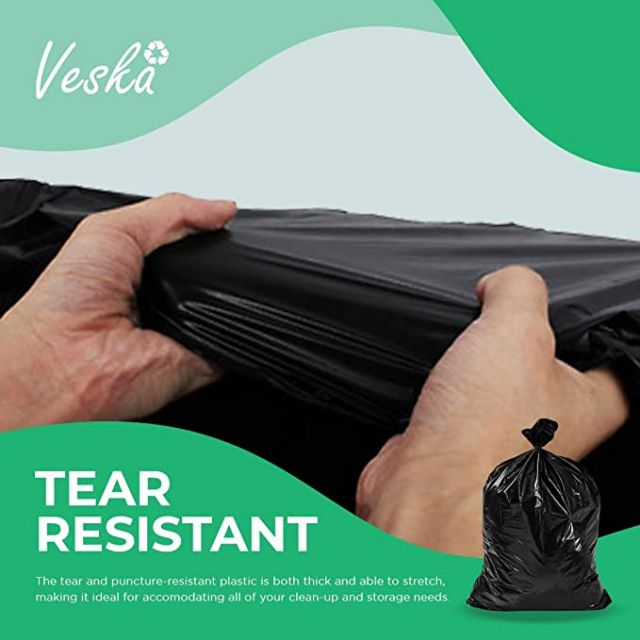
When procurement managers and facility supervisors evaluate refuse sacks for commercial or industrial waste disposal, the question of maximum load capacity inevitably arises. A refuse sack that tears under load creates safety risks, operational delays, and additional disposal costs. Yet load capacity is not a single fixed number printed on every package. It is determined by an interplay of material thickness, bag construction, waste type, fill technique, and handling conditions. Understanding these variables helps buyers specify the right refuse sacks for their operational environment and avoid the recurring problem of bag failures.
How Load Capacity Is Measured and Rated
Refuse sack load capacity is typically expressed in two ways: weight rating in pounds or kilograms, and volume rating in gallons or liters. A refuse sack labeled as 50-gallon, 40-pound capacity means it can hold up to 50 gallons of waste volume and support up to 40 pounds of weight under ideal conditions. However, these ratings are based on laboratory tests using uniformly distributed, non-abrasive filler material. In real-world waste handling, load capacity is affected by waste density, moisture content, the presence of sharp objects, and the angle at which the bag is lifted. Manufacturers following ISO 9001 quality management standards typically test refuse sacks using standardized protocols such as ASTM D1709 for dart drop impact and ASTM D882 for tensile properties, which together provide a more reliable indication of real-world load-bearing performance than a simple printed weight rating.
The Relationship Between Mil Thickness and Load Capacity
Mil thickness is the most commonly referenced metric for refuse sack strength, but it is not the only factor. A 2.0 mil sack can support approximately 25 to 35 pounds of evenly distributed dry waste, while a 3.0 mil sack can support 40 to 55 pounds under similar conditions. The relationship is not perfectly linear because film formulation and manufacturing consistency matter just as much as raw thickness. A refuse sack manufactured with consistent gauge control across its entire surface area will outperform a nominally thicker bag that has thin spots caused by uneven extrusion or stretching during production. For heavy commercial applications such as restaurant kitchens, manufacturing facilities, and institutional waste handling, refuse sacks in the 2.5 to 3.0 mil range with reinforced bottom seals are generally recommended.
Bottom Seal Design and Its Impact on Weight Tolerance
The bottom seal is often the weakest structural point of a refuse sack. Simple heat-sealed seams can separate under as little as 15 to 20 pounds of load if the waste is concentrated at the bottom center. Star-sealed bottoms, which use multiple overlapping layers fused together, distribute weight across a larger surface area and can support 30 to 50 percent more weight than a flat heat seal of the same mil thickness. Some premium refuse sacks use a gusseted bottom with an additional reinforcing patch, which further increases load tolerance. When specifying refuse sacks, buyers should always confirm the bottom seal type, as two bags with identical mil ratings can have dramatically different load capacities depending on seal construction.
Waste Type and Fill Technique Variables
The type of waste being collected has a significant effect on real-world load capacity. Dry, lightweight materials such as paper, cardboard, and packaging foam allow refuse sacks to reach their rated capacity. Wet waste, which is common in food service and outdoor applications, can reduce effective capacity by 30 to 40 percent because water adds substantial weight per unit volume. Sharp-edged waste such as broken glass, metal can lids, and rigid plastic shards reduces load capacity further by creating concentrated stress points that can initiate tears at loads well below the rated limit. Fill technique also matters: waste dropped into a bag from height generates impact forces that briefly exceed the static weight, and unevenly distributed waste creates localized loads that exceed the film's tensile strength at specific points.
Practical Load Testing for Procurement Decisions
Rather than relying solely on manufacturer specifications, institutional buyers can implement a simple in-house load testing protocol. A common approach involves filling sample refuse sacks with the actual waste mixture typical of the facility to 50, 75, and 100 percent of the stated volume capacity, then lifting and carrying each bag a standard distance while observing for deformation, thinning, or seal separation. Bags that pass the 75 percent fill test but fail at 100 percent suggest that the published capacity rating should be derated in practice. Buyers working with experienced refuse sack manufacturers such as SUNHO Packing can request production samples for field testing and receive technical guidance on matching bag specifications to their specific waste profile, drawing on the manufacturer's experience with institutional and industrial accounts.
Calculating Total Cost Beyond Unit Price
Maximum load capacity directly affects the total cost of refuse sack usage. A lower-capacity sack that requires more frequent changes, more bags per waste volume, and increased labor time for cleanup after failures may cost significantly more in total operational expense than a higher-capacity sack with a higher unit price. A facilities team processing 200 bags per day that reduces failure rate from 5 percent to 1 percent by switching to properly specified refuse sacks saves approximately 8 bags per day in replacement costs alone, plus the labor hours associated with spill cleanup. When evaluating total cost, buyers should consider bag failure rate, labor time per change, spill cleanup time, and injury risk as quantifiable factors that often outweigh the per-unit bag cost difference.
Questions and Answers
How do I calculate the right refuse sack size for my bins?
Measure the bin's top circumference and height, then select a sack with a flat width of at least half the circumference and a length that exceeds the bin height by 6 to 8 inches for proper overlapping. An undersized sack will stretch and lose load capacity, while an oversized sack wastes material and can catch on bin edges.
Does temperature affect refuse sack load capacity?
Yes, significantly. Polyethylene film becomes more brittle at low temperatures, reducing puncture resistance and load capacity in cold storage or outdoor winter applications. At high temperatures above 40 degrees Celsius, the film softens and stretches more easily, which can lead to deformation and bottom seal failure under load.
Can I stack filled refuse sacks during storage?
Stacking is not recommended for routine waste disposal because the weight of upper sacks compresses lower sacks and can cause bottom seal failure over time. If stacking is unavoidable, limit stacks to two bags high and use refuse sacks rated for at least 50 percent more weight than the actual contents.